


Description
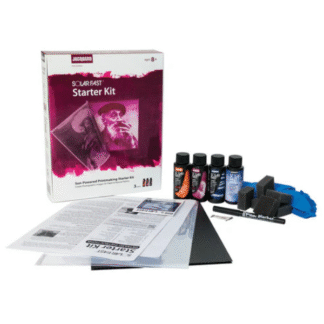
Jacquard SolarFast builds on this tradition while removing much of the technical barrier. Rather than working with iron salts and chemistry, artists apply pre-mixed, ready-to-use dye directly to fabric by hand, with a brush, through a screen, or with a printing block. They then expose the printed fabric to direct sunlight. The UV energy in sunlight activates the dye, which bonds permanently to the fibres. After exposure, the fabric goes through a wash with SolarFast Wash (#902), which removes all unexposed dye and leaves behind only the fixed, cured colour in the areas that received sunlight.
The creative possibilities of this process extend well beyond flat colour. Sun printing involves placing objects directly onto the dye-painted fabric before exposure. The objects block the UV light from reaching the fabric beneath them, leaving their silhouettes in the original undyed colour of the cloth while the surrounding areas cure to the full depth of the dye. Leaves, feathers, lace, cut paper stencils, found objects — anything flat enough to sit against the fabric surface can function as a negative. The results have a quality that is impossible to achieve with conventional printing: crisp edges where the object blocked the light and soft gradients where partial light reached the edges.
SolarFast also works as a straightforward fabric dye for hand-painted and screen-printed designs. Artists who do not want to incorporate the photogram technique can simply paint or print the dye onto fabric, expose it to sunlight, and wash out the unexposed areas. The colour that remains is permanent and lightfast — it will not fade with washing or prolonged display under normal lighting conditions.
The dyes work on natural fibres: cotton, linen, rayon, silk, and wool. They also work on leather. Synthetic fibres such as polyester and nylon do not absorb the dye effectively because the molecular structure of synthetic fibres does not allow the dye molecules to bond in the same way as natural cellulose or protein fibres.
Exposure time depends on the intensity of the sunlight at the time of exposure. A bright midsummer day at high altitude will cure the dye in a shorter time than an overcast winter afternoon at sea level — relevant context for South African artists, where sunlight intensity varies significantly between highveld and coastal conditions. Testing a small sample before committing to a full piece is always recommended.
The SolarFast Wash (#902) is not optional — it is an integral part of the process. The Wash removes all unexposed dye, stops the curing reaction, and clears the fabric of any residual colour that was not fixed by UV exposure. Without it, the unfixed dye will continue to slowly expose in ambient light, muddying the design, and will bleed into adjacent areas in the wash. Using the correct Wash in the correct proportion is what separates clean, professional results from muddy, indistinct ones.
Colours can be mixed together before application to extend the available palette. The dyes are intermixable across the range. Artists working with the full palette of 14 colours plus the capacity to mix can achieve a very wide range of results.
This range works well for:
- Sun printing and photogram work on fabric.
- Natural dyeing artists who want UV-cure technology with familiar textile results.
- Screen printing and block printing on natural fibre cloth.
- Mixed-media textile work combining dye with stitch, resist, or discharge.
- Art education environments where the sunlight-activation process is part of the learning experience.
- Gift for textile artists, surface designers, and craft enthusiasts.


Reviews
There are no reviews yet.