Inktober
By Barry Lategan
Every October, artists around the world return to one of the simplest creative acts: placing a line on a page.
Inktober began in 2009 as artist Jake Parker’s personal challenge to improve his inking skills and develop a regular drawing habit. It has since grown into a worldwide event, with artists using the daily prompts as a reason to draw, experiment and share their work.
The traditional challenge is 31 drawings in 31 days. That can be wonderfully motivating, but it can also become another obligation in an already busy life. Inktober is a challenge, not a competition. One drawing, ten drawings or all 31 can still mean that you spent more time making art than you otherwise might have.
There is something rather honest about ink. A pencil allows us to hesitate and erase. Ink asks us to put down the line and then work with whatever happens next. The mark may wander, bleed or surprise us, but this is often where a drawing begins to find its character.
Before choosing what to draw, however, it is worth looking at the material itself. Ink has travelled a very long road to reach the bottles, cartridges and pens we use today.
Before the Fountain Pen
Some of the earliest writing inks were carbon inks. Soot or lampblack was mixed with water and a binder such as gum or animal glue. Ancient Egyptian scribes wrote on papyrus using carbon-based black ink, with red ink often used for headings, emphasis and important passages.
Early Chinese ink traditions also developed around finely ground soot and binders. The mixture was dried into solid ink sticks, then ground with water on an inkstone when needed. In the hands of a skilled calligrapher or painter, the depth of black could range from the faintest grey wash to an almost velvety darkness.
These inks were beautiful and durable, but they contained tiny solid particles. That was not a problem for a brush, reed pen or dip pen. Inside the narrow channels of a fountain pen, however, those same particles could collect, dry and eventually block the flow.
This remains one of the most useful lessons in the history of ink: an ink can be excellent for drawing and still be completely wrong for a fountain pen.
The Age of Iron Gall Ink
For centuries, iron gall ink was one of the most important writing inks in Europe and much of the Western world.
It was traditionally made by combining tannin-rich tree galls with iron salts, water and, frequently, gum arabic. The galls themselves are small growths formed by trees in response to insects. From such an unassuming beginning came the ink used for countless manuscripts, letters, records, drawings and official documents.
Iron gall ink could appear pale when first placed on the page and then darken as it reacted with the air. It produced a fine, permanent line, which made it invaluable in an age when records were expected to endure.
Its permanence came at a price. Poorly balanced historical mixtures could be highly corrosive. Conservators still encounter documents on which iron gall ink has browned, cracked or eaten into the paper itself.
Modern iron gall inks intended for fountain pens are generally much gentler than their historical ancestors. Even so, it is wise to follow the manufacturer’s instructions, avoid leaving the ink to dry inside a pen and clean the pen regularly.
Putting the Ink Inside the Pen
The idea of a pen carrying its own supply of ink is much older than the modern fountain pen. Inventors experimented with reservoir pens for centuries, but reliable ink flow was difficult to achieve. Too little air entering the reservoir caused the pen to stop; too much could release a small flood onto the page.
By the end of the nineteenth century, improvements to feeds, nibs and filling mechanisms had made practical fountain pens possible on a much larger scale.
Ink now had a more demanding job. It needed to remain fluid inside the reservoir, travel through extremely fine channels, lubricate the nib, dry within a reasonable time and leave as little residue as possible.
Traditional carbon mixtures and waterproof drawing inks were not suited to this task. An ink containing shellac, acrylic binder or coarse pigment could dry inside the feed and turn a fine writing instrument into a very elegant paperweight.
Chemistry Brings Colour to the Bottle
The growth of the fountain pen coincided with the development of synthetic dyes during the nineteenth century. These new colourants made it possible to produce strong, repeatable colours that dissolved in water and flowed more readily through a pen.
The familiar foundation of fountain-pen ink began to take shape: water, soluble dye and small amounts of other ingredients to control flow, lubrication, drying and shelf life.
For much of the twentieth century, practical colours ruled the desk. Black, blue and blue-black were the colours of classrooms, offices, ledgers and letters. Manufacturers concentrated on inks that started reliably, dried quickly and behaved themselves on everyday paper.
Cartridges eventually made refilling cleaner and more convenient, but bottled ink never disappeared. In recent years, it has enjoyed a remarkable creative revival.
The Modern Ink Cabinet
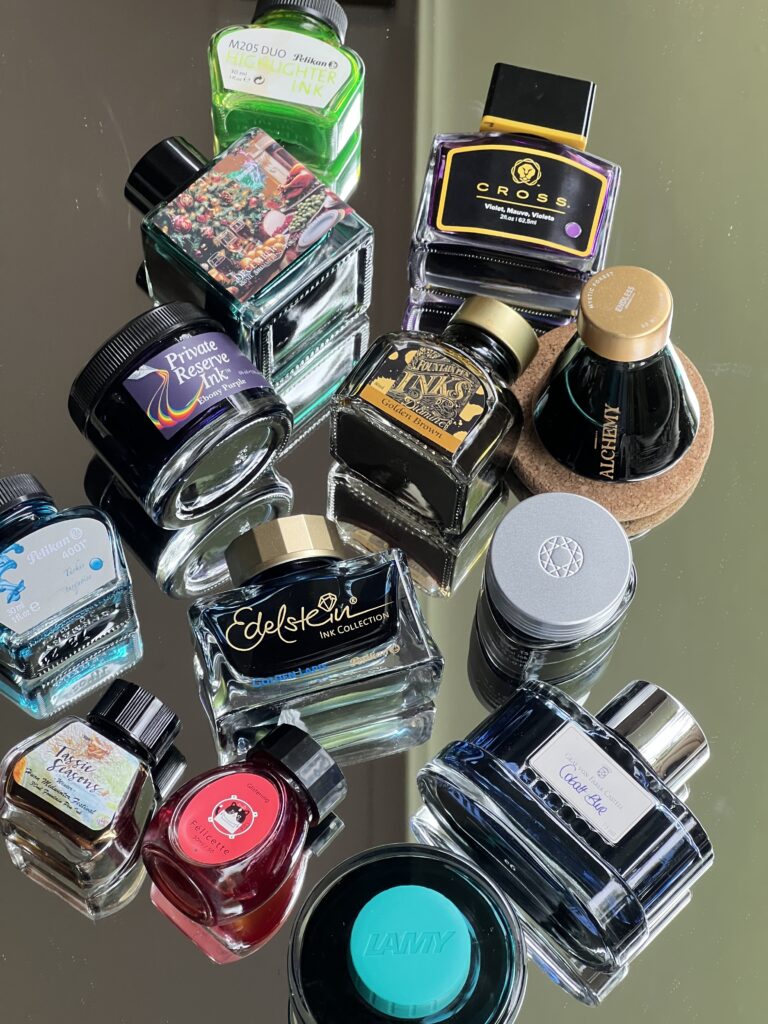
Today, fountain-pen ink is available in an astonishing range of colours. There are restrained office blues and sombre greys, but also burnt oranges, dusky violets, bright teals, earthy browns and greens that seem to contain an entire forest.
Colour is only part of the story. Modern inks can also produce effects that reveal themselves as the line dries.
Shading
Shading occurs when an ink dries lighter in one part of a stroke and darker where more ink has pooled. It can give handwriting and drawings a sense of depth without changing colour.
Sheen
Sheen appears when a heavily saturated dye remains near the surface of suitable paper and reflects a contrasting colour in the light. A blue ink, for example, may produce a red or coppery sheen when the page is tilted.
Shimmer
Shimmer comes from reflective particles suspended in the ink. These particles catch the light and create a sparkling effect. Shimmer inks can be great fun, although they usually benefit from a broader nib, gentle agitation before filling and more attentive pen cleaning.
Pigment Ink
Modern pigment fountain-pen inks contain extremely fine particles and can offer far better water resistance than ordinary dye-based inks. They are especially useful to artists who want to draw a line and then apply watercolour over it. The important words are fountain-pen safe: never assume that a pigmented drawing ink belongs in a fountain pen simply because it looks fluid in the bottle.
Ink, Nib and Paper: A Three-Way Conversation
An ink does not create shading or sheen by itself. The paper and the pen have their say too.
Very absorbent paper pulls ink quickly into its fibres. This may shorten drying time, but it can also cause feathering, bleeding and flatter-looking colour. A smoother, less absorbent sheet allows the ink to sit near the surface, where shading and sheen have a better chance to appear.
The nib changes the result again. A fine nib offers control and detail. A broad nib puts down more ink and shows colour variation more readily. Flexible and stub nibs can add changes in line width, although they also require a little patience and practice.
No single combination is right for every artist. Part of the pleasure lies in discovering which pen, ink and paper seem to understand one another.
For a deeper comparison of ink types and their compatibility with different tools, visit the Artsavingsclub Ink Guide.
Fountain-Pen Ink as an Artist’s Medium
Fountain-pen ink is often treated purely as a writing material, but it can be wonderfully expressive in a sketchbook.
A fountain pen can create crisp outlines, hurried observational sketches, controlled hatching, stippling and loose, energetic lines. Unlike a disposable fineliner, it can be refilled with another colour when the mood changes.
Many dye-based inks can also be drawn outward with a wet brush to create washes. Some separate into unexpected component colours as water moves across the page. A dark grey may reveal violet at its edges; a brown may quietly separate into rust, yellow or green. The result is not always predictable, which is precisely what makes it interesting.
There is another side to this freedom. Many dye-based fountain-pen inks are neither waterproof nor especially lightfast. A drawing may change if it becomes wet or spends years in strong sunlight. For a sketchbook, that may not matter. For work intended for exhibition or sale, permanence deserves more careful thought.
If you plan to add watercolour over a drawing, make a small test first. Draw a few lines, allow them to dry and pass a wet brush over them. Some inks will remain firmly in place; others will dissolve into a dramatic wash. Neither response is wrong. They simply lead to different kinds of picture.
A Small but Important Warning
Never assume that every bottle labelled “ink” is suitable for a fountain pen.
India ink, acrylic ink, calligraphy ink and many traditional drawing inks are designed for brushes and dip pens. They may contain shellac, acrylic binders or pigments that can dry permanently inside a fountain-pen feed.
If the bottle does not clearly state that the ink is suitable for fountain pens, keep it out of your fountain pen. Use a dip pen or brush instead.
Artsavingsclub carries separate collections of fountain-pen inks and drawing inks, making it easier to choose an ink intended for the tool in your hand.
A More Human Way to Approach Inktober
Drawing every day can build confidence and loosen a hand that has become overly cautious. It can also become exhausting if each prompt is treated as a demand for a finished masterpiece.
It helps to decide, before October begins, what success will mean for you. It may be a complete drawing every day. It may be three drawings a week, ten minutes of sketching before breakfast or simply finishing one small sketchbook during the month.
Keep the subjects manageable. An old shoe, a coffee cup, the contents of a pocket or the view through a window can be enough. A simple object drawn with attention will usually say more than an ambitious idea rushed to meet a deadline.
Try different lines. Fill one page with hatching, another with broken marks and another with a brush wash. Use black ink if you enjoy its directness, but do not feel imprisoned by tradition. The official spirit of Inktober leaves room for different tools, colours and approaches.
Most importantly, allow imperfect drawings to remain in the book. They are not failures. They are evidence that you were there, looking closely and practising.
A missed day does not mean the challenge is broken. It is simply a missed day. Open the sketchbook again when you can.
A Line Through History
From soot gathered near a flame to inks engineered to shade, sheen and shimmer, ink has always brought chemistry and human expression together.
Its ingredients have changed, but its essential purpose has not. Ink turns a thought, an observation or a passing gesture into a visible mark. The person who mixed soot thousands of years ago and the artist opening a sketchbook this October are separated by centuries, but the impulse is much the same.
That is what makes ink such a fitting medium for Inktober. It connects an ancient urge to make marks with a modern invitation to practise, experiment and share.
Start with the materials you already have, or explore Artsavingsclub’s range of inks, pens and writing tools and sketchbooks.
Then fill a pen, open a page and begin. The line does not need to be perfect. It only needs to be yours.