
An Expert Resource for Fine Writing Instruments
The nib is the heart, soul, and mechanical engine of a fountain pen. It dictates how your instrument meets paper, how ink behaves under fluid dynamics, and ultimately, how hand movement translates into unique expression. For a specialist purveyor of fine writing tools like Artsavingsclub, helping a writer locate their ideal nib requires balancing traditional sizing rules, metallurgic properties, and understanding the specialized craft of the world’s elite nib foundries.
The Core Standard Nibs
Standard factory nib configurations are categorized by the physical width of the tipping sphere welded onto the point. This sizing governs daily utility and ink output.
| Size Designation | Standard Western Code | Approx. Line Width | Ideal Application Profile |
| Extra Fine | EF | 0.3mm – 0.4mm | Ultra-compact handwriting, margin notation, detailed artistic stippling. |
| Fine | F | 0.4mm – 0.6mm | Universal everyday note-taking, optimal performance on generic copy paper. |
| Medium | M | 0.6mm – 0.8mm | Standard Western signature and journaling standard; high ink lubrication. |
| Broad | B | 0.8mm – 1.0mm | Showcasing high-sheen, multi-chromatic, or heavily shaded specialty inks. |
| Double Broad | BB | 1.0mm+ | Large, dramatic scripts, public signatures, or acting as base stock for custom grinds. |
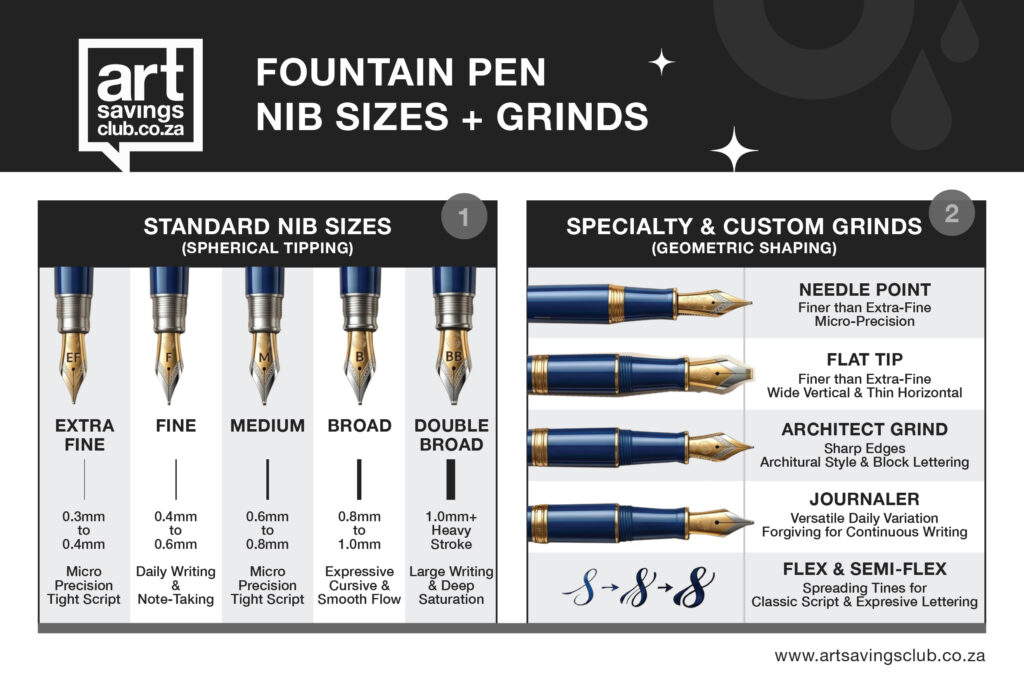
Specialty & Custom Grinds
Beyond traditional spherical configurations, custom grinds profile the tipping material geometrically to create instantaneous line variation dictated strictly by direction.
Needlepoint: Ground manually under magnification to produce lines significantly finer than standard factory extra-fines. Designed to maximize density inside tiny layouts, such as 3.7mm Hobonichi planner grids.
Stub 1.1 / 1.5 (Flat Tip) : Ground flat horizontally with softened edges. It automatically provides broad vertical strokes and hair-thin horizontal lines without requiring deliberate user hand pressure. Perfect for immediate calligraphic flair.
Architect Grind, (often referred to as Scribe ): The geometric inverse of a stub. Ground sharp to give thin vertical strokes and remarkably wide horizontal lines. Highly prized by technical drafters and block-lettering styles.
Journaler: Originally introduced to the modern market by Esterbrook as a medium stub reincarnation of the vintage Esterbrook 9314M nib. It is explicitly rounded on the corners to allow fast, catch-free, daily long-form journaling while retaining typographic personality.
Flex & Semi-Flex (EFF / FF): Utilizing prolonged side cuts, thinner profiles, and high-elasticity metal, these tines spread under structural down-force. This physical variance maps ink width dynamically to the writer’s downstroke pressure.
The M (Medium) nib provides the classic line width resulting in a smooth and consistent writing experience. Versatile and reliable, it’s suitable for various writing styles and occasions. It lays down a smooth, moderately wet line that is forgiving on most paper types and perfectly balances crisp legibility with rich ink shading | The Stub 1.1 nib features a unique flat edge, creating varied line widths depending on the angle of the pen. This nib, with its 1.1mm width, offers a broad line on the downstroke and remains fine from east to west, making it perfect for calligraphy-style writing. Add flair and personality to your writing with the expressive strokes of the Stub 1.1 nib. |
The Sizing Divide: European vs. Eastern Nibs
A fundamental concern when matching an instrument to a client is origin geography. Western and Eastern foundries engineer their target line profiles based on cultural typographic demands.
| The Structural Rule of Thumb: Eastern (Japanese) factory nibs consistently write approximately one full size finer than their Western (European or American) literal equivalents. Size_Japanese (Fine) ≈ Size_Western (Extra-Fine) | Size_Japanese (Medium) ≈ Size_Western (Fine) |
Western Foundries (e.g., Lamy, Pelikan, JoWo): Engineered for Western continuous script and cursive, requiring highly lubricated, wetter, and broader paths of ink flow to glide continuously across paper texturing.
Eastern Foundries (e.g., Pilot, Sailor, Platinum): Explicitly engineered to resolve the complex, high-stroke density of Kanji, Hanzi, and Japanese character sets. To render these intricate characters cleanly without intersecting ink blots, the physical tolerances must be narrower, creating highly managed, ultra-crisp, finer paths of ink.
TWSBI fountain pen nibs generally write true to standard Western sizes, but they tend to produce broader, wetter lines when compared to Japanese brands like Pilot or Sailor. Because TWSBI uses Western-sized nibs (often manufactured by JoWo), they lay down more ink and create a wider mark than many Eastern counterparts.
Metallurgy & Plating
Gold Nibs (14k, 18k, 21k)
Gold’s high density and inherent material malleability give premium nibs a luxurious, cushioned feedback. Gold effectively acts as a microscopic shock absorber for the hand, buffering the texture of textured paper. Additionally, gold is completely immune to chemical oxidation and corrosion from acidic or vintage iron-gall inks.
Stainless Steel (Commonly Designated as ‘Silver’ Nibs)
High-grade stainless steel arrays (like those deployed by Lamy and Esterbrook) provide a highly reliable, structurally uniform, and robust writing experience. Steel remains stiff under heavy hand pressure, serving as an exceptional daily option for fast carbon copying, rapid note-taking, or EDC (Everyday Carry) transit.
Rhodium Finishes
Rhodium is an ultra-premium, silver-white precious metal belonging to the platinum family. It is electroplated over gold nib bodies to alter their coloration from yellow-gold to striking bright silver while completely preserving the underlying soft, responsive characteristics of the gold core. This coordinates internal performance with silver, platinum, or chrome pen accoutrements.
Nib Manufacturers Explained
While many luxury houses craft exquisite resin and celluloid bodies, very few fabricate the high-precision internal mechanical nib units themselves. The market relies predominantly on a specialized trio of internal engineering architectures.
JoWo Berliner Schreibfeder GmbH (The Global Standard)
Based in Berlin, Germany, JoWo is arguably the premier manufacturer of interchangeable nib assemblies globally. Renowned for supreme manufacturing consistency, their flagship #5 and #6 threaded units are the foundational engines driving elite luxury houses including Esterbrook, Opus 88, and Conklin. Writers choose JoWo for its predictability, outstanding ink management via highly engineered plastic feeds, and structural modularity. If an Esterbrook enthusiast wishes to convert an Estie from a Fine to a Stub 1.1, the JoWo housing unscrews effortlessly, allowing clean, instant field replacement.
Bock (Peter Bock GmbH)
Another titan of German precision engineering based in Heidelberg, Peter Bock GmbH has supplied high-end writing points since 1939. Bock units are highly regarded for their specific feedback profiles and slightly more generous, wet ink flows. They are widely utilized by benchmark houses such as Kaweco, Visconti, and Tactile Turn. Bock assemblies often exhibit a touch more spring and elasticity compared to their JoWo counterparts within the same alloy configurations, appealing to writers who enjoy a highly expressive, soft performance.
In-House Foundries (Proprietary Autonomy)
At the pinnacle of regional autonomy are brands that refuse third-party mechanisms, designing and forging their nib configurations entirely in-house. Lamy represents the ultimate execution of Western industrial in-house design, producing its legendary Z50 steel and Z55 gold lines in Heidelberg to ensure rigorous interchangeability across almost its entire product ecosystem. In the East, Japanese masters like Pilot, Sailor, and Platinum maintain independent, secretive gold foundries. These house-designed nibs offer singular profiles—such as Sailor’s 21k gold compound or Pilot’s legendary custom configurations—that cannot be emulated by multi-client European foundries. In-house engineering ensures a proprietary, tailored harmony between the feed, ink delivery, and ergonomics.
In Summary
The finer nibs (EF,F,Stub 1.1) are designed for detailed writing, offering precise lines for intricate work. On the other hand, the broader nibs (B,BB) deliver a more generous flow of ink, ideal for bold statements and expressive strokes. The flex nibs (Extra FF,EFF) offer additional versatility, allowing for dynamic line variation and expressive writing styles.
TWSBI summarises rather effectively:
A quick no brainer guide in choosing nib sizes in an overly complicated fountain pen world:
If you write small, go with an EF
For the normal writer, F is the most popular
If you tend to lean on a bigger font, M will be perfect
B is for statements!! Sign a check in B, write a header in B, do some coloring/shading in B
Stub nibs are italic in writing style (have a special card or invitation to write?
Keep in mind that your actual line width will also vary based on:
- Ink Wetness: Well-lubricated or wetter inks will result in broader lines.
- Paper Absorbency: More absorbent papers allow ink to spread, creating a thicker stroke.
- Pressure: Pressing down harder forces more ink out, widening the mark.