




Description
We tested the Naturals range – read our latest blog.
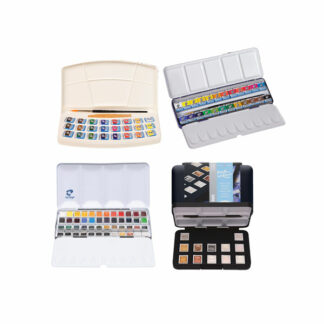
Shop the Schmincke Naturals Watercolour Sets.
Shop the traditional Horadam Aquarell Watercolour Half Pans & Tubes.
View the comprehensive Schmincke range.
Lightfastness:
To make the seven plant-based colours in the Schmincke Horadam Naturals range, soluble plant dyes are precipitated onto an insoluble matrix. This process, known as ‘laking’ has been used for centuries to improve the lightfastness of dyes and make them suitable for making artist paints. However, lake pigments are not as lightfast as many modern pigments.
The lightfastness of the Horadam Naturals range has been tested in Schmincke’s in-house laboratory using the Blue Wool Scale. The test consists of eight strips of wool fabric, each dyed with a different dye with different defined lightfastness properties. The paint samples (applied on watercolour paper as a gouache-layer of 30µm) are tested alongside these control strips. The test is carried out for around 1600 hours until the most lightfast test strip, level eight, begins to fade slightly. The colour is compared with the test strips and given a lightfastness rating based on the blue wool strip that most closely matches the change in the colour sample. According to the Blue Wool Scale, a rating of eight is the highest, while one is the lowest.
To communicate lightfastness on their tubes, Schmincke use a 1-5 star rating which is given according to the Blue Wool Scale test. Stil de Grain has a two star rating (a four on the Blue Wool Scale) and it has the lowest lightfastness of the range. The other plant-based colours are rated between three and four stars (between five and seven on the Blue Wool Scale), depending on the dye-stuff that has been used to make it.
The 16 individual colours:
Rügen chalk (110): Warm, transparent, highly lightfast white. Genuine chalk pigment, fine and natural, derived from fossilized calcium carbonate. Chalk has been used in cave paintings and remains visible in such locations today.
Kamala (220): A transparent orange-yellow ochre with natural graininess and excellent lightfastness. Kamala is extracted from the glands and tufted hairs of the fruits of the monkey face tree, a tree-like Euphorbiaceae.
Curcuma (250): A subdued warm yellow with good lightfastness and semi-transparent characteristics. Curcuma, or turmeric, comes from the ginger family, and its roots contain a yellow dye primarily used in dyeing. Curcuma holds significant cultural importance in Indian traditions, being used for over 4000 years. Pigment: NY3.
Dragon’s Blood (320): A semi-transparent, woody red with very good lightfastness. The dye is named after an ancient legend involving a bloody battle between an elephant and a dragon, whose blood mixed on the ground, giving rise to a tree. The resinous secretions of the dragon’s blood tree are reddish-brown and used to produce the pigment. Pigment: NR31.
Indigofera (470): A semi-transparent denim blue with very good lightfastness. Natural indigo is obtained from the Indigofera plant, yielding a somewhat dull bluish-black shade. Indigo has been used as a dye in Roman paintings from the 1st century AD, early medieval miniatures, and paintings across all periods of European art, with the oldest evidence dating back to 3000 BCE. Pigment: NB1.
Dyers’ Green (510): A typical plant or leaf green with semi-transparent characteristics and good lightfastness. The colour is achieved through the combination of Curcuma and Indigo, two crucial pigments in dyeing. Pigments: NY3, NB1.
Celadonite (530): A delicate grey-green with transparent characteristics and very good lightfastness. The term Celadonite is derived from the French word celadon, meaning sea green.
Madder Lake (360): A semi-transparent, brownish red with very good lightfastness. Madder lake pigment (also known as Alizarin red) is made from the madder root using a historical recipe. Traces of this pigment were discovered in the tomb of the Egyptian Pharaoh Tutankhamun from 1300 BCE.
Stil de Grain (610): A yellowish-green brown with transparent characteristics and satisfactory lightfastness. This shade is obtained by lacquering buckthorn berries, following a recipe by Paul Schützenberger from 1873. Stil de Grain can be found in formulations dating back to the 16th century and was a popular pigment until the late 19th century.
Yellow Ochre (620): A semi-opaque, orange-brown ochre with good lightfastness, obtained from natural iron oxide. Yellow ochre is one of the oldest pigments and has been used in prehistoric paintings.
Red Bolus (640): A reddish-brown, semi-opaque earth tone with good lightfastness, resembling the well-known red chalk. The pigment comes from deposits in Upper Franconia, Bavaria. Bolus, from the Greek word bolos, means earth lump and refers to a reddish-coloured clay. Red bolus is one of the oldest pigments, and drawing pencils from red bolus were sawn directly from clay-rich soils in the early Renaissance.
Lalvarit Violet (650): A muted, violet-brown tone with very good lightfastness and transparent characteristics. The pigment is Andesite rock originating from lava flows. This igneous rock is grey but has a unique violet colour due to natural iron and manganese oxide components.
Caucasus Earth (680): A delicate, cool olive green with very good lightfastness and semi-opaque characteristics, made from a green pigment obtained in the Caucasus region.
Green Slate (720): A cool, semi-transparent light grey with good lightfastness, made from genuine ground slate. Its greenish colour comes from the presence of minerals like epidote, actinolite or similar minerals.
Graphite Black (730): A deep, neutral dark colour, opaque, with very good lightfastness, made from ground natural graphite. Graphite has been mined for thousands of years, and after wet cleaning, the graphite pigment contains a carbon content of up to 98%. The name graphite comes from the ancient Greek graphein, meaning to scratch, write, draw or paint. This pigment has been used for drawings since ancient times, and since the 16th century, a graphite-clay mixture has been used in almost all pencils.
Vine Black (750): A deep, opaque black with very good lightfastness. Vine black has a dark anthracite tone and tends to have a slight bluish tint when mixed with white. In ancient times, vine black was the most commonly used carbon black. It was obtained by carbonizing, heating under exclusion of oxygen, young shoots of grapevines.



Reviews
There are no reviews yet.